|
So you got the job? Congratulations, new head doctor! But now comes the hard part: Keeping the job. Here are some tips on how to be a leader that your team and your clients can trust.  Conducting your Business/ What To Do:Delegate and EmpowerHaving the right team allows you to lead rather than just manage. When each member of a team has their own role to play, the practice can function smoothly.
Effective Time ManagementLeading efficiently includes enforcing effective time management.
Establish lines of communicationMaking clear lines of communication and a system for sending out news, is setting your team up for success.
Conducting yourself/How to be:Lighten upImagine a stressful day at the clinic. Everyone rushing about, many clients waiting for their prescriptions, more patients waiting to be examined, the occasional pet yowling in the background… You get the picture. A veterinarian's job is frustrating enough, but as leader, the weight of making the big decisions may be heavy on your shoulders. For your own mental health and that of your team, you should learn to lighten up.
 Be humbleNo one likes a show-off, right? Naturally, no one likes to be led by one either. Humility is a critical trait in a strong individual, and strength is crucial for leadership. This is one of the rarer attributes of good leaders because it means putting aside one’s ego. ‘Humility isn't thinking less of yourself-it's thinking of yourself less.' ~C.S Lewis As mentioned in the importance of being open-minded in the previous article, finding the balance between the confidence as a role model and the overconfidence of being centre-focus, is crucial . Remember: you are the boss but your crew does not constitute of subordinates, but of capable doctors. They are the ones who give your title as leader meaning, because without them there would be no team to lead, so treat them well. Inspire and MotivateComing down to its definition, leadership is the ability to “inspire, influence and guide others to participate in a common effort.” Real leaders don’t just bark orders, they take part in the process, by using effective communication and motivation to help their squads take action, and make progress. On the way, remember to involve them, ask for their input, keep them informed, and give timely and specific feedback.  So good luck! Whether you're just starting out as head doctor or you have had earlier experience, there's always room for improvement. Hopefully, these tips will bring you closer to you, your team and your practice closer to your goal. For more on the subject, check out the resources we used:
1. The 7 Most Common Leadership Styles (and How to Find Your Own) -https://www.americanexpress.com/en-us/business/trends-and-insights/articles/the-7-most-common-leadership-styles-and-how-to-find-your-own/ 2. 5 veterinary leadership skills every boss needs to learn - https://www.dvm360.com/view/5-veterinary-leadership-skills-every-boss-needs-learn 3. Who Are the Leaders in Your Practice? Growing a Healthy Practice Through Leadership -https://todaysveterinarypractice.com/practice-building-leaders-practice-growing-healthy-practice-leadership/ 4. Understanding veterinary leadership in practice- https://core.ac.uk/download/pdf/267018976.pdf 5. How to be a great leader at work - https://www.avma.org/education/leadership-development/how-be-great-leader-work
0 Comments
Remember back in school, when a teacher would group you into teams and ask someone to take over as leader. Were you the one who volunteered up front to lead the team? Were you sitting on the side, willing to let the others step up? Or perhaps you waited to see if anyone else wanted to, and then threw your hat in the ring? There are 7 basic styles of leadership, to suit all the different types of teams and their captains: 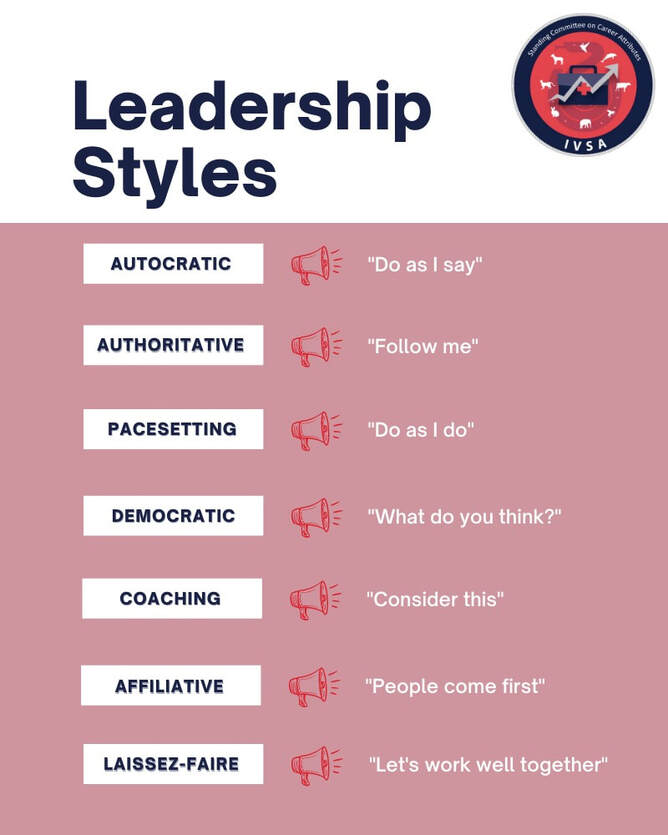 The leadership styles that you would respond to, or the style you would command your team with, vary from person to person. But whichever one you were or are now, the importance of leadership and of having someone to guide a team is universally acknowledged. Some people are blessed with characteristics that make a great leader, and some less lucky people have to work their way up to the position. Thus, with the right qualities and the ability to apply them- they can’t just be empty words on a resume, right?- one can learn to lead. So what are these qualities?Being confidentThis is the most important prerequisite for applying to a position of leadership. Because when you aim higher, you must have confidence in yourself to do so; People can believe in someone who believes in themselves. However, finding the line between being poised or confident and being over-confident and cocky is the deciding factor between whether your team will want to follow you. Communicating wellCommunication is an understated soft skill. How you express yourself to others is vital and if done poorly, it can make for a person who is hard to trust, or believe in. Would you leave the success of your team in the hands of someone unreliable? Great leaders are clear, truthful and genuine; consistency shows a grounded presence. It shows that you are someone who can be counted on by your teammates or juniors.  Being a Role ModelIf you’ve ever worked at a clinic, or even been to one: you must have observed it. The way that the junior doctors look up to the head doctor. Before making a final diagnosis, giving an important prescription, or deciding on the manner of treatment, they will confirm with the main doctor. As a leader, you must be one to set the standard for your team. Your actions, your behaviour and decisions must be an example to the others to follow. And thus you can be held accountable by them. And so leaders who work hard and are polite to their team and clients, all while providing consistent care to patients, gain respect and naturally encourage others to be the same. Having an open-mindHave you ever liked those team captains who did not have room for suggestions from their teams? They were never wrong and did not like to be corrected. Leadership is not for Know-it-alls. If it were, the team would have a dull atmosphere where people stop sharing ideas and don’t enjoy participating.  A good leader knows only one thing for certain: that they are not always right. Accepting different opinions and listening to new ideas shows that they know that they don’t have all the answers, and gives the team members chances to contribute. So keep your ears and eyes open! Taking ResponsibilityOne of the best qualities of a leader is being able to accept responsibility for their team. If and when something goes wrong, leaders are to do less complaining and assigning blame, and more focussing on the problem and finding the solution. ‘With great power, comes great responsibility.’ ~ Uncle Ben, Spiderman It may just be a cliche quote from a Marvel comic, but it means something very important: the power to lead is accompanied by the strength to shoulder the weight of your team. If you are ready to take the credit for your team’s success, then you also need to be prepared to take the blame, should your team fail. Providing a VisionHaving a vision for your entire veterinary team is the main role of a practice owner or leader. This is because knowing where you and your practice will stand in the years to come, is a significant part of securing the position of leader itself. Who would trust a leader who has no plan for the future? And once you have a doable objective, share it with your practice, so your employees know what they’re working towards. When team members know the vision and goals of the practice, they understand how their individual role helps to drive the success of the business. Consider implementing team meetings, so you have a dedicated time to share the vision and discuss its progress.  And those are fundamental qualities you find in a leader, and what people will look for, in the person in charge. If you are reading this to learn what are the basic necessities in a leader, in order to apply for the job, then these are the most essential things to be worked on. Good luck! If you have acquired your desired position of leadership, and are looking for how to do the job well, stay tuned for the next article, where you will learn what is expected of a good leader. For more on the subject, check out the resources we used:
1. The 7 Most Common Leadership Styles (and How to Find Your Own) -https://www.americanexpress.com/en-us/business/trends-and-insights/articles/the-7-most-common-leadership-styles-and-how-to-find-your-own/ 2. 5 veterinary leadership skills every boss needs to learn - https://www.dvm360.com/view/5-veterinary-leadership-skills-every-boss-needs-learn 3. Who Are the Leaders in Your Practice? Growing a Healthy Practice Through Leadership -https://todaysveterinarypractice.com/practice-building-leaders-practice-growing-healthy-practice-leadership/ 4. Understanding veterinary leadership in practice- https://core.ac.uk/download/pdf/267018976.pdf 5. How to be a great leader at work - https://www.avma.org/education/leadership-development/how-be-great-leader-work |